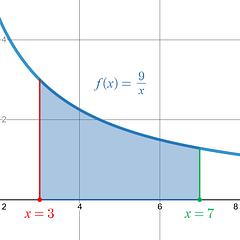
Example 1: Definite Integral ln(x)
|
|
|||||
|
Step 1: Simplify and look for algebraic rewrites.
None in this example. |
|
||||
|
Step 2: Identify any term(s) that includes the base case .
Here you have 1 chunk, and it is the base case . |
|
||||
|
Step 3: Take the antiderivativeof the special cases using their specific Recipe. Chunk 1: n = 9 |
|
||||
|
Step 4 ( Definite Integral ONLY ): Evaluate the antiderivative result using the Top – Bottom method. |
|
||||
|
Final Result Meaning: Remember the Definite Integral will always provide you a definite value , and the Indefinite Integral provides you a family of solutions . |
The Net Area between the curve and the x-axis on the x-interval [ 3 , 7 ] is 7.625 .
Since the final result is positive, you know without even seeing the graph that there is more area above the x-axis than below it.
|
||||